

You have paid your rent or mortgage, household bills, groceries and other monthly expenses, and there is still £100, £300 or perhaps £500 left in your account. The next question is surprisingly difficult: should you keep that spare money in savings or invest it for the future?
There is no single answer that works for everyone. Saving and investing serve different purposes, and the right decision depends on when you expect to need the money, whether you already have emergency savings, whether you are carrying expensive debt and how comfortable you are with investment risk.
For most beginners, the decision should not start with finding the investment offering the highest potential return. It should start with building strong financial foundations and deciding what the money is actually for. This SavingGuideHub guide explains how UK beginners can approach the save-or-invest decision without making it unnecessarily complicated.
Saving usually means keeping your money in a bank, building society or another cash-based savings product. Depending on the account, you receive interest while your original cash balance remains relatively stable. Common options include easy-access savings accounts, fixed-rate accounts, regular savers and Cash ISAs.
Investing means putting money into assets whose value can change. These could include shares, bonds or investment funds containing many different assets. Investments have the potential to generate greater long-term growth than cash, but there is no guarantee that they will do so.
Your investment could increase significantly over time, remain relatively flat or fall below the amount you originally invested. That possibility of loss is what makes investing fundamentally different from depositing money into a normal savings account.
The simplest way to think about it is that saving generally prioritises stability and accessibility, while investing accepts additional risk in pursuit of potentially greater long-term growth.
Before comparing savings rates, investment funds or Stocks and Shares ISAs, decide when you expect to need the money. Your timeframe can immediately eliminate some unsuitable options.
If you are saving for a holiday next summer, a car next year or a house deposit you expect to use relatively soon, protecting the money may be more important than trying to maximise its potential return. A significant market decline shortly before you need the money could leave you with less than expected.
The FCA encourages people considering investments to think about a longer timeframe, with at least five years commonly used as a useful example. Having more time gives investments greater opportunity to recover from shorter-term market movements, although recovery and positive returns are never guaranteed.
Money needed next year and money intended for retirement several decades away therefore have completely different jobs. Treating both in exactly the same way can create unnecessary risk.
Before putting spare money into investments, consider what would happen if your income suddenly stopped or you faced an unexpected £1,000 expense. Without accessible cash, you might need to borrow money or sell investments at an inconvenient time.
MoneyHelper recommends considering expensive debt and building emergency savings before investing money that will not be needed for the next few years. An emergency fund provides a financial buffer for expenses such as urgent home repairs, car problems or a temporary loss of income.
Emergency money generally needs to remain accessible. If you invest your entire emergency fund and markets fall just before you need the cash, you could be forced to sell at a loss.
If you have not yet established a financial safety net, our guide to building an emergency fund from scratch can help you decide how much to build and where to start. Once you have accessible emergency money, it becomes easier to consider investing genuinely long-term cash.
Investing while carrying expensive debt can create an awkward financial situation. Your investment return is uncertain, but the interest being charged on your borrowing continues according to your credit agreement.
Imagine you have £3,000 on a credit card charging a high rate of interest and £200 available each month. Investing that £200 might produce a positive return, but it could also fall in value. Reducing expensive borrowing, on the other hand, reduces interest costs that would otherwise continue accumulating.
That does not mean every debt must always be cleared before anyone invests. A mortgage at a relatively low rate is very different from expensive credit-card borrowing or an overdraft. You need to consider the interest rate, repayment conditions and any penalties before deciding.
If expensive borrowing is already taking up a significant part of your monthly income, focusing on how to pay off debt faster may provide a stronger financial foundation before committing substantial money to investments.
Saving generally makes more sense when you need the money within the next few years, cannot afford for its value to fall or require quick access to it. This makes cash savings particularly useful for emergency funds and short-term financial goals.
Suppose you have accumulated £10,000 towards a house deposit and expect to buy within 18 months. Investing the money could expose your deposit to a market decline just when you need it. Keeping it in an appropriate savings product may offer less potential growth, but it also avoids stock-market volatility.
Savings may also suit people who are uncomfortable with investment losses. If watching £10,000 temporarily fall to £8,000 would cause you to panic and immediately withdraw the money, your ability to tolerate investment risk may be lower than you initially thought.
You can still make your savings work harder by comparing available products. Our easy access vs fixed savings account guide explains how to balance accessibility with interest-rate certainty when deciding where to hold cash.
Investing becomes more relevant when your short-term finances are reasonably secure and the money is intended for a goal several years into the future. You should also be comfortable accepting that your balance will sometimes fall.
For example, someone may already have an emergency fund, manageable debts and enough income to cover regular expenses. If they then have £200 each month available for a goal 15 or 20 years away, investing could become something worth considering.
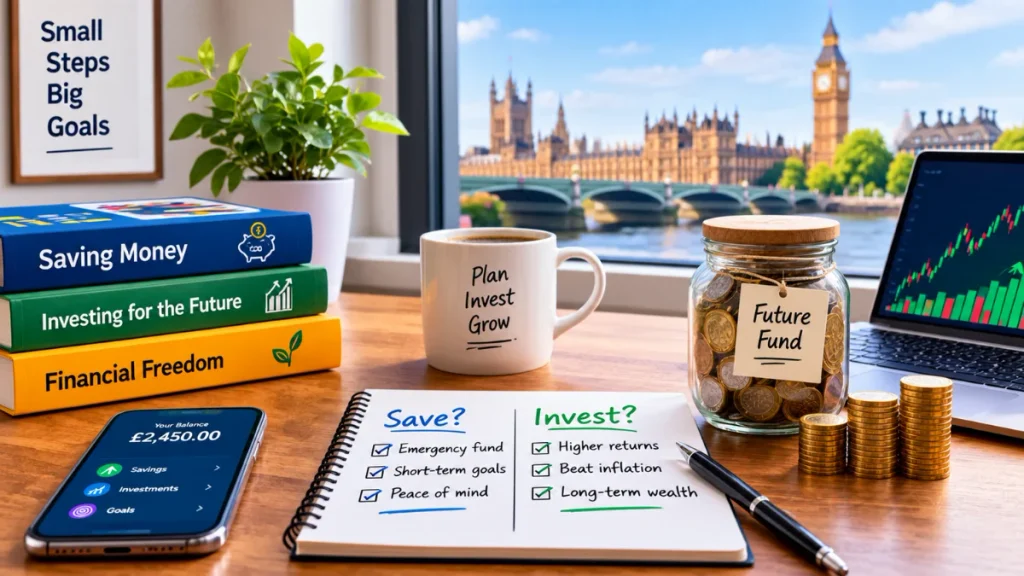
The longer timeframe matters because financial markets can experience significant short-term falls. If you do not need to withdraw the money immediately, you have more opportunity to remain invested through periods of volatility.
However, time does not remove investment risk. Even long-term investors are not guaranteed a profit, which is why investing should involve money you can afford to leave invested rather than cash needed for essential expenses.
Saving and investing are sometimes presented as competitors, but they are better understood as tools for different financial goals. The following comparison highlights the main differences UK beginners should understand.
| Factor | Saving | Investing |
|---|---|---|
| Value of money | Generally stable in deposit accounts | Can rise or fall |
| Potential return | Usually lower | Potentially higher over the long term |
| Suitable timeframe | Shorter-term goals | Usually longer-term goals |
| Emergency fund | Generally suitable | Generally unsuitable |
| Access | Depends on account | Depends on investment and platform |
| Market risk | No direct stock-market risk | Investment values can fluctuate |
| Inflation | Cash may lose purchasing power | Potential to outperform inflation, but not guaranteed |
| Return certainty | Interest may be fixed or variable | Returns are not guaranteed |
| Typical purpose | Emergency and short-term savings | Long-term wealth-building goals |
The key difference is therefore not simply which option could produce more money. You need to consider how much certainty, accessibility and risk are appropriate for the goal.
Cash feels safe because £10,000 normally continues to appear as £10,000 in your account before interest and withdrawals. However, the amount displayed in your bank account is only part of the story.
Inflation increases the general price of goods and services over time. If your savings earn interest at a slower rate than prices are increasing, the purchasing power of your money can gradually decline.
For example, imagine your savings grow from £10,000 to £10,300 after interest. Your balance has increased by £300, but if prices have risen faster during the same period, the £10,300 may buy less than £10,000 could previously buy.
This is one reason investing can become relevant for long-term goals. Investments have the potential to outperform inflation over longer periods, but there is no guarantee that they will do so. Inflation risk therefore does not mean emergency savings should suddenly be moved into the stock market.
You do not need a large salary or thousands of pounds sitting in your bank account before you can begin improving your finances. Even £100 of genuinely spare money each month can become meaningful when allocated consistently.
If you do not have emergency savings, you could initially direct that £100 towards building your cash buffer. After 12 months, you would have contributed £1,200 before any interest.
Once your emergency fund reaches a level that suits your circumstances, you can reconsider what future £100 contributions should achieve. If the money is intended for a long-term goal and you understand investment risk, some of it could potentially be invested. If you are saving towards something needed relatively soon, continuing with cash may make more sense.
The important decision is not whether £100 is enough to invest. It is whether that £100 has a short-term or long-term job.
Having £500 available each month creates more options, but it does not mean the entire £500 should automatically go into one savings account or investment.
Suppose you are still building your emergency fund while also planning for retirement. You might decide to direct part of the money towards accessible savings while another portion goes towards a workplace pension or another appropriate long-term objective.
Someone with expensive credit-card debt could have completely different priorities. They may decide that reducing the debt deserves most of the £500 before increasing investment contributions.
This is why setting clear financial goals is important. Rather than asking where to put £500, decide what you want different portions of the £500 to accomplish and then choose suitable financial products.
If you are employed in the UK, your workplace pension should be considered before deciding where all of your additional long-term money should go.
Under qualifying automatic-enrolment arrangements, minimum pension contributions are generally based on qualifying earnings. The usual minimum total is 8%, with at least 3% coming from the employer and the remainder associated with the employee contribution, including applicable tax relief.
Some employers offer contributions above the minimum or will match additional employee contributions up to a certain level. If your employer offers matching and you are not taking full advantage of it, check how the scheme works before deciding where additional retirement money should go.
Pensions also benefit from tax advantages, although access is restricted because the money is intended for retirement. That makes a pension very different from an ordinary savings account that you can use for next year’s expenses.
The correct choice depends on the purpose of your money. Retirement savings and a house deposit should not automatically use the same financial product.
A Stocks and Shares ISA is a UK tax-efficient account that can hold qualifying investments such as investment funds, shares and certain bonds. It is often one of the first account types UK beginners encounter when researching investing.
For the 2026/27 tax year, the overall ISA subscription allowance is £20,000. Money invested within a Stocks and Shares ISA receives the tax treatment available under ISA rules.
However, an ISA is a tax wrapper rather than an investment itself. Opening a Stocks and Shares ISA does not determine how much risk you take because that depends on the investments you choose to hold inside it.
It is also important to distinguish between a Stocks and Shares ISA and a Cash ISA. A Cash ISA holds cash savings, while a Stocks and Shares ISA contains investments whose value can rise and fall. UK ISA rules can change, so check current GOV.UK guidance before making decisions based on allowances or tax treatment.
One of the biggest misconceptions is that people eventually stop saving once they begin investing. In reality, a well-organised financial plan can contain both.
Your current account might contain enough money for bills and everyday spending. A separate easy-access savings account could hold your emergency fund, while another pot contains money for predictable future expenses.
You can use sinking funds for costs such as annual insurance, car maintenance, holidays or home repairs. Because those expenses are expected, keeping the money separate can prevent them from disrupting your normal monthly budget.
Money intended for goals many years away could then potentially be invested separately. This creates layers in your finances rather than forcing every pound into either cash or investments.
The SavingGuideHub approach is to give each pool of money a purpose before deciding which product should hold it.
Beginners sometimes assume investing means choosing a few companies they expect to perform well. That can create significant concentration risk because the success of your portfolio becomes heavily dependent on a small number of businesses.
Diversification means spreading your investments across multiple companies, sectors, geographic markets or asset types. It cannot eliminate investment risk, but it can reduce your dependence on the performance of one company or market segment.
Investment funds can provide one way to achieve diversification because a single fund may hold many different assets. However, funds vary considerably in strategy, cost and risk, so diversification should not be assumed simply because something is labelled a fund.
The FCA encourages investors to understand diversification as part of managing investment risk. Beginners should therefore focus on understanding what they own rather than trying to identify the next company whose share price might rise dramatically.
Imagine you invest £10,000 and markets subsequently fall by 20%. Your investment would then be worth approximately £8,000 before considering fees or other factors.
If the money is intended for a goal 15 years away, you may have the option to remain invested and allow time for markets to change. If that same £10,000 is your emergency fund and you suddenly need £7,000, you have a much bigger problem.
You could be forced to sell investments during the downturn and turn what might have been a temporary decline into an actual loss.
Separating short-term and long-term money reduces the likelihood of this happening. Accessible savings can cover unexpected costs while long-term investments are left to pursue their intended objective.
Beginners do not necessarily need a large lump sum before investing. Many investment platforms allow regular monthly contributions, although minimum deposits, investment choices and fees vary.
Regular investing can make the process easier to automate. Instead of trying to decide whether today is the perfect day to invest, you contribute a predetermined amount according to your long-term plan.
When markets fall, the same contribution can purchase more units of an investment. When prices rise, it buys fewer. Regular contributions therefore spread purchases across different market conditions, although they do not prevent losses.
Lump-sum investing is another possibility when you already have long-term money available. However, whichever approach you consider, check platform fees, fund charges, trading costs and other expenses because fees reduce the return you ultimately keep.
Risk tolerance is easy to overestimate when markets are rising. The real test comes when your investment falls significantly.
Imagine investing £20,000 and later seeing the balance fall to £16,000. Would you remain comfortable with your long-term plan, or would you feel compelled to sell everything immediately?
If a temporary £4,000 decline would make it impossible for you to sleep at night, your investment strategy may involve more risk than you can realistically tolerate.
Your ability to take risk also depends on your financial circumstances. Someone with stable income, substantial emergency savings and a 20-year timeframe may be able to tolerate more volatility than someone who expects to need the money in three years.

Investment decisions should therefore consider both your emotional tolerance for losses and your financial ability to absorb them.
Beginners are frequently targeted by investment promotions promising high returns with little or no risk. Social media, messaging apps and unsolicited calls can make these opportunities appear more legitimate than they are.
Be particularly cautious when someone guarantees profits, pressures you to transfer money quickly or claims that an investment offers unusually high returns without meaningful risk.
Before dealing with a financial firm, check its regulatory status where appropriate using official FCA resources. Do not rely solely on links or contact details supplied by the person promoting the investment, because scammers can impersonate legitimate businesses.
Remember that legitimate investing involves risk. A promise of high guaranteed returns should therefore make you more cautious rather than more interested.
The decision becomes easier when you work through your finances in the right order. Start with money required for rent or mortgage payments, bills, groceries and normal monthly expenses. That cash needs to remain readily available.
Next, consider emergency savings. Build an accessible financial buffer that can protect you from unexpected costs or income disruption without forcing you to borrow or sell investments.
Then look at expensive debt. If high-interest borrowing is costing you substantial money each month, reducing it may deserve priority over taking additional investment risk.
After those foundations are reasonably secure, separate your remaining goals by timeframe. Money needed within the next few years will often be better suited to cash savings, while genuinely long-term money may be suitable for investment consideration if you understand the risks.
If your monthly finances are already tight, our guide on how to budget on a low income can help you organise essential spending and savings before committing money to longer-term investments.
The following table shows how the decision might change according to your financial situation rather than simply according to the amount available.
| Situation | £100–£500 Spare Money Could Potentially Prioritise |
|---|---|
| No emergency savings | Building accessible savings |
| Expensive credit-card debt | Reducing high-cost borrowing |
| Saving for next year’s holiday | Cash savings |
| House purchase planned soon | Appropriate short-term savings |
| Retirement several decades away | Pension/investment consideration |
| Emergency fund already established | Short- and long-term goals can be separated |
| Unsure when money will be needed | Maintaining greater accessibility |
This is not a recommendation that everyone in each situation should make exactly the same choice. Income, debt, tax position, employment benefits, risk tolerance and personal goals can all change what is appropriate.
The purpose of the table is to show why the destination of spare money should depend on its job rather than simply its size.
So, should you save or invest your spare money? For UK beginners, the answer usually becomes clearer once you stop treating saving and investing as competing choices.
Money needed for bills, emergencies and shorter-term goals generally needs stability and accessibility. Money intended for a genuinely long-term objective may have more opportunity to benefit from investing, provided you understand that its value can fall and returns are never guaranteed.
Before investing, review expensive debt, establish accessible emergency savings and understand your workplace pension. Then separate your remaining goals according to when the money will be needed.
For many people, the eventual financial plan will include both savings and investments. The important part is giving each pound a clear purpose before deciding where it belongs.
Neither option is universally better. Saving generally suits emergency money and shorter-term goals, while investing may be considered for longer-term objectives where you can accept market fluctuations and the possibility of losing money.
There is no universal amount. Your emergency fund should reflect your essential expenses, income stability and personal circumstances. MoneyHelper recommends considering emergency savings and expensive debt before investing money you will not need for several years.
Emergency money generally needs to remain accessible because you cannot predict when it will be required. Investing it could expose the balance to a market decline at the same time that you need to withdraw it.
High-cost borrowing generally deserves particular attention because the interest cost is known while investment returns are uncertain. However, different types of debt have different rates and conditions, so consider the actual cost of your borrowing.
Eligible bank deposits do not experience stock-market fluctuations in the way investments do, and qualifying deposits can receive FSCS protection subject to the scheme’s rules. Investments can rise or fall in value and may return less than you originally invested.
Yes. You can keep emergency and short-term money in savings while investing separate money towards longer-term objectives. The two approaches can perform different roles within the same financial plan.
Many platforms allow relatively small regular contributions, although minimum amounts and fees vary. The more important question is whether the £100 is genuinely available for a long-term goal after your short-term financial needs have been considered.
Investing is generally considered a longer-term activity. FCA consumer guidance commonly uses at least five years as a useful timeframe, although a longer period does not guarantee a positive return.
A Cash ISA holds cash and pays interest according to the account terms. A Stocks and Shares ISA holds investments whose value can rise and fall. Both operate within ISA rules, but they involve very different levels of investment risk.
If your employer contributes to your workplace pension or offers additional matching, understand those benefits before deciding where retirement contributions should go. Pensions can provide tax advantages and employer contributions but also restrict when the money can normally be accessed.

Contributor at SavingGuideHub, writing practical guides on finance, savings, and insurance.

Sharing practical finance and savings guidance.


