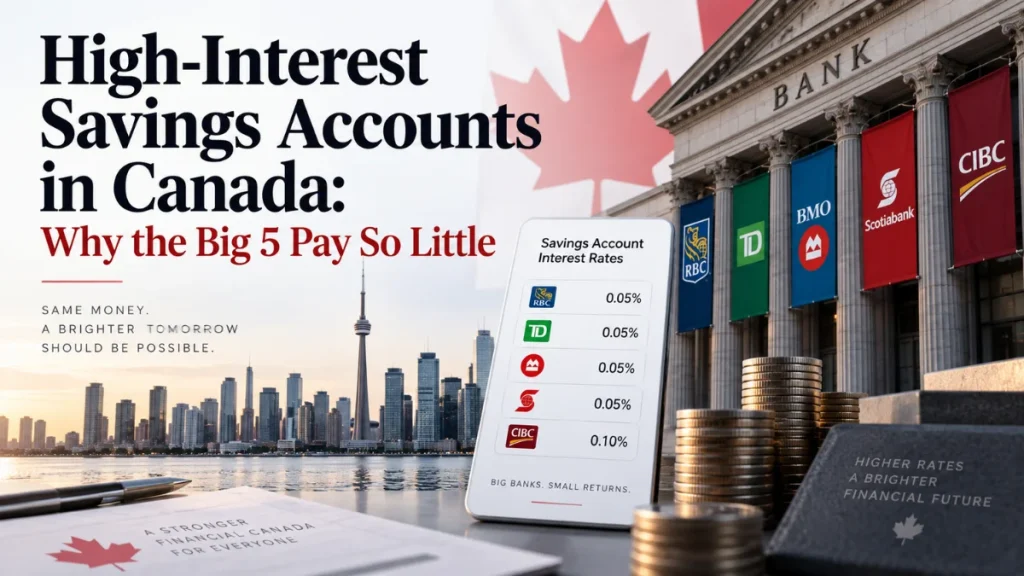
Keeping money in a savings account feels like one of the safest and simplest financial decisions you can make. But there is a catch: your money may be sitting safely while earning surprisingly little interest. That becomes particularly frustrating when other financial institutions advertise high-interest savings accounts in Canada with noticeably better rates.
So why can Canada’s biggest banks offer relatively low rates on some savings accounts while smaller or online institutions compete much harder for deposits? The answer involves customer behaviour, competition, banks’ funding needs, promotional offers and the convenience that keeps millions of Canadians with the same financial institution for years.
In this SavingGuideHub guide, we’ll explain how high-interest savings accounts in Canada work, why savings rates differ so much, what promotional rates really mean and what to check before moving your money.
A high-interest savings account, commonly called a HISA, is a savings account designed to pay interest while generally keeping your money accessible. Unlike some Guaranteed Investment Certificates (GICs), a typical HISA does not require you to lock your savings away for a predetermined term, although individual accounts can have their own withdrawal and transfer conditions.
The Canada Deposit Insurance Corporation describes a HISA as a savings account that may offer a higher rate than a regular savings account without requiring you to lock the money in for a specific period. However, the words “high interest” do not guarantee a particular return, which means consumers still need to compare actual rates and account conditions. (cdic.ca)
That distinction matters because one institution’s “high-interest” account might offer a rate that is considerably lower than a competitor’s ordinary savings product. Instead of relying on the product name, look at the regular annual interest rate, promotional conditions, balance tiers, fees and accessibility.
One reason is relatively simple: large banks do not always need to offer market-leading interest rates to attract deposits. Millions of Canadians already use major financial institutions for their salary deposits, chequing accounts, mortgages, credit cards, investments and everyday payments. Once several financial products are connected through the same bank, convenience can become a powerful reason to stay.
A smaller bank or online financial institution may need to offer a more competitive savings rate to convince someone to open another account and move their money. A major bank with a huge existing customer base may face less pressure to offer the highest rate on every savings product.
Banks also have different funding needs. Deposits are one way financial institutions fund their operations, but how valuable additional deposits are to a bank can change over time. Consequently, savings rates reflect each institution’s funding strategy, competition and market conditions rather than simply moving automatically with one central interest rate.
There is nothing inherently wrong with keeping your savings at the same bank you use for everyday transactions. Seeing your chequing account, credit card, mortgage and savings in one app can make your finances easier to manage. However, convenience can become expensive when it stops you from periodically checking whether your savings account remains competitive.
Suppose you have C$20,000 sitting in the same savings account you opened years ago. You might carefully compare mobile phone plans, insurance premiums and grocery prices while never checking what that C$20,000 is earning. Even a difference of one or two percentage points can become meaningful when applied to a larger cash balance over several years.
Regularly checking savings rates should therefore form part of learning how to manage your money better. You do not need to switch banks every few months, but knowing what your current account pays gives you the information needed to decide whether convenience is worth the potential difference in interest.
One of the biggest sources of confusion with high-interest savings accounts in Canada is the difference between regular and promotional rates. A financial institution might advertise an impressive percentage on its homepage, but that number may apply only to new customers, new deposits or money held in the account during a limited introductory period.
Imagine Bank A advertises 4.50% for three months before the rate falls to 0.75%. Bank B, meanwhile, offers 2.50% without an introductory bonus. Bank A immediately appears better, but someone planning to leave their money untouched for a year needs to calculate the return over the full 12 months rather than comparing 4.50% with 2.50%.
Whenever an offer uses terms such as “up to”, “bonus rate”, “welcome offer”, “new deposits only” or “limited time”, check the conditions carefully. Promotional rates can still be worthwhile, but they should be evaluated separately from the regular rate that applies after the promotion expires.
Smaller financial institutions and online banks sometimes use attractive savings rates as a way to compete for customers. If an institution does not have the enormous existing customer relationships enjoyed by Canada’s biggest banks, offering better interest can provide savers with a clear reason to open an account.
Different business models can also affect costs, although it would be inaccurate to say that online banks always offer better rates simply because they have fewer branches. Deposit pricing depends on competition, funding requirements and the institution’s wider financial strategy.
For consumers, the practical lesson is straightforward: your chequing account and savings account do not necessarily need to be at the same institution. You might keep everyday banking where it is convenient while holding some short-term savings elsewhere if another suitable account offers better terms.
Interest rates can look insignificant when expressed only as percentages. Converting them into dollars makes the potential difference much easier to understand. Consider a simplified example in which C$10,000 remains in an account for approximately one year.
| Annual Interest Rate | Approx. Interest on C$10,000 |
|---|---|
| 0.01% | C$1 |
| 0.50% | C$50 |
| 1.00% | C$100 |
| 2.00% | C$200 |
| 3.00% | C$300 |
| 4.00% | C$400 |
These figures are simplified illustrations. Your actual interest will depend on whether the rate changes, how the institution calculates and compounds interest, whether you add or withdraw money and the tax treatment of your savings.
Still, the comparison demonstrates why checking your savings rate matters. A small percentage difference may not mean much on C$100, but it can become significant when C$10,000, C$25,000 or more is sitting in cash.
Savings accounts normally quote an annual interest rate, but the way interest is calculated and paid can differ between financial institutions. The Financial Consumer Agency of Canada explains that financial institutions may calculate savings interest based on factors including your balance and the number of days involved. Compound interest means previously earned interest can also begin generating interest.
Compounding can improve your return over time, particularly when money remains untouched for longer periods. However, compounding cannot turn a very low underlying rate into a strong return. The actual annual rate remains one of the most important numbers to check.

When comparing high-interest savings accounts in Canada, look beyond phrases such as “daily interest” or “compound savings”. Understand the annual rate available on your balance, how frequently interest is paid and whether the rate is variable.
Broader interest-rate conditions in Canada influence borrowing and savings rates throughout the financial system, but banks do not have to move savings rates by exactly the same amount as the Bank of Canada’s policy rate. Each institution decides what it is prepared to pay for deposits based on its own funding needs and competitive position.
When financial institutions strongly want additional deposits, competition can encourage more attractive HISA offers. When they need deposits less urgently or broader interest rates decline, savings rates can also fall.
This means a competitive HISA today may not remain competitive indefinitely. Unless your savings product guarantees a particular rate for a specified period, the institution can generally adjust the rate according to its terms. Checking your savings account periodically is therefore worthwhile.
A regular savings account and a HISA serve similar basic purposes. Both allow you to separate cash from everyday spending while earning some interest. The main differences generally involve the interest rate and the conditions attached to the account.
The name itself should not determine your choice. A product carrying an impressive “premium high-interest” label could potentially offer a lower effective return than a simply named savings account at another institution. Compare actual rates, balance requirements, fees and accessibility rather than relying on marketing language.
A HISA can be particularly useful for short- and medium-term money that needs to remain relatively accessible. That could include an emergency fund, future home deposit, tax payment, holiday fund or money reserved for a large upcoming purchase.
A high-interest savings account can be a practical place for emergency savings because it may allow you to earn interest without sacrificing easy access to your cash. An emergency fund is intended for genuine financial shocks, so liquidity and stability generally matter more than chasing the highest possible return.
Before choosing an account, check how quickly money can be withdrawn or transferred, whether withdrawals involve fees and whether the account has any conditions that could make accessing your money difficult. A slightly higher rate may not be worth much if accessing your emergency savings becomes inconvenient when you urgently need them.
If you have not started one yet, our guide on how to build an emergency fund explains how to set a realistic target and gradually create a financial buffer without trying to save the entire amount at once.
Emergency savings are not the only cash that could potentially benefit from earning interest. Money reserved for predictable expenses such as Christmas, holidays, annual insurance premiums, car maintenance or technology replacement may also sit unused for several months before you need it.
These planned savings are commonly known as sinking funds. Instead of allowing a C$600 annual expense to hit one month’s budget, for example, you might save C$50 each month and gradually build the amount in advance. Keeping those funds in an appropriate interest-paying savings account can allow them to earn something while waiting to be spent.
The important difference is that sinking funds cover expected expenses, whereas an emergency fund protects you against genuinely unexpected financial problems. Using both can make irregular bills much easier to handle.
A Guaranteed Investment Certificate serves a different purpose from a high-interest savings account. With a GIC, you generally place money under specific terms in exchange for a defined return. Depending on the product, your ability to withdraw the money before maturity may be limited.
A HISA normally provides greater flexibility because you can access the savings more easily, although the interest rate can change. A GIC may provide greater certainty about the return for its term, but that certainty can come with less liquidity.
Neither option is automatically better. If you might need the money next month, locking it into a non-redeemable GIC may be inappropriate. If you know you will not need a portion of your savings for a specified period, comparing GIC rates alongside HISAs can make sense.
A Tax-Free Savings Account and a HISA are frequently compared as though they are two competing bank accounts, but they describe different things. A HISA is a savings product, whereas a TFSA is a registered account structure that can hold eligible savings and investments.
The Canada Revenue Agency explains that a TFSA can hold cash and eligible investments, while income generated within the account is generally tax-free subject to TFSA rules. Depending on the financial institution, you may therefore be able to hold an interest-paying savings product within a TFSA.
Before contributing, check your available contribution room and the current CRA rules. Overcontributing can result in tax consequences, so a TFSA should not be treated as an unlimited savings account simply because withdrawals and eligible earnings receive favourable tax treatment.
Interest earned in an ordinary non-registered savings account is generally taxable in Canada. The Canada Revenue Agency states that interest and other investment income must be reported, including in certain situations where you may not receive a T5 slip.
That means the advertised HISA rate does not necessarily represent your final after-tax return. The tax impact depends on your individual circumstances and whether the savings are held inside or outside a registered account.
This is another reason to set your financial goals before choosing where to keep money. The most appropriate account for an emergency fund may not be the same account you would choose for a longer-term savings goal.
Eligible deposits held at a Canada Deposit Insurance Corporation member institution can receive CDIC protection. CDIC generally covers eligible deposits up to C$100,000, including principal and interest, separately within each insured category at each member institution.
However, consumers should not assume that everything labelled “HISA” receives identical protection. CDIC explains that HISA ETFs and HISA mutual funds are not covered in the same manner as eligible savings deposits. Different structures can therefore produce different protection.
If you are considering moving a large amount to an unfamiliar institution because it offers an attractive rate, verify the institution and the specific account before transferring the money. Provincially regulated credit unions may also operate under provincial deposit-protection arrangements rather than CDIC.
Earning more interest is useful, but it makes little sense to gain C$100 in additional interest while losing a similar amount through unnecessary banking charges. When comparing financial institutions, look at the entire banking relationship rather than focusing exclusively on one savings rate.
Monthly account charges, ATM fees, transfer costs, overdraft charges and other banking expenses can gradually eat into your money. Learning how to avoid bank fees can therefore be just as valuable as searching for a better savings rate.
Ideally, the account should allow your money to earn a competitive return without introducing fees or restrictions that outweigh the benefit.
Earning interest does not automatically mean your purchasing power is growing. If prices increase faster than your savings rate, your account balance may rise while the amount of goods and services your money can buy effectively declines.
Suppose your savings account earns 2% over a year while consumer prices rise by 3%. You have still earned interest, but your savings have not completely kept pace with the increase in prices. This is known as a negative real return.
That does not mean emergency savings should automatically be placed in riskier investments. Cash provides stability and accessibility that can be extremely valuable. Instead, inflation is another reason to avoid leaving substantial savings in a near-zero-interest account without checking whether an appropriate alternative exists.
Higher housing, food, transport and everyday expenses can make it harder for households to put money aside in the first place. Understanding the cost of living in Canada can therefore be an important part of deciding how much you can realistically save each month.
A better HISA rate will not solve affordability problems, but it can help make the savings you already have work more efficiently. If you have worked hard to build C$5,000, C$10,000 or C$25,000 in cash reserves, knowing what that money earns is part of sensible financial management.
This is especially important when the money has a clear future purpose. Savings for a home, emergency fund or annual expense should not be forgotten simply because they are temporarily sitting in cash.
Not necessarily. The point of comparing high-interest savings accounts in Canada is not to assume that big banks are bad or that smaller institutions are always better. Instead, you should determine whether your current account still meets your needs.
Start by finding your current regular savings rate. Calculate approximately how much interest that rate would generate on your existing balance over one year. Then compare several suitable alternatives and calculate the potential difference in actual Canadian dollars.

After that, consider fees, access, customer service, transfer times and deposit protection. If another account would earn only C$10 more over an entire year, keeping everything together for convenience might be perfectly reasonable. If the difference is several hundred dollars, investigating another account becomes considerably more worthwhile.
Promotional savings rates can be useful, particularly when you already have a substantial amount of cash. However, repeatedly moving money from one temporary offer to another requires organisation and attention to the terms.
You need to know when each promotion ends, which deposits qualify and what rate takes over afterwards. You may also need to maintain accounts at several institutions, which makes your financial system more complicated.
The goal should be a good overall return with reasonable convenience rather than winning a competition for the highest advertised percentage. For many savers, a consistently competitive rate can be more practical than a spectacular three-month promotion followed by a very low regular rate.
Before opening a HISA, compare more than the headline percentage. Start with the regular interest rate and then determine whether the advertised figure includes a temporary promotional bonus. Check how long the promotion lasts, whether it applies to your entire balance and whether existing customers qualify.
Next, examine fees, minimum-balance requirements, transfer limits and withdrawal conditions. You should also confirm how interest is calculated, whether the rate changes at different balance levels and how quickly you can access the money.
Finally, verify applicable deposit protection. These checks take longer than simply choosing the account with the biggest number on an advertisement, but they give you a much clearer idea of what you will actually receive.
Imagine two people each have C$25,000 in savings. Person A keeps the money in an account paying 0.10%, while Person B uses an appropriate account paying 3%. For simplicity, assume both rates remain unchanged for an entire year and ignore compounding and tax.
Person A would earn approximately C$25 in interest. Person B would earn approximately C$750. That creates a difference of roughly C$725 without either person contributing additional money.
Real accounts are more complicated because rates can change, promotional conditions can expire and taxes may apply. Nevertheless, the example demonstrates why larger cash balances deserve occasional attention.
Getting a higher savings rate can help, but it should be viewed alongside the cost of your debt. If you are paying a very high interest rate on a credit card while earning a much lower percentage on excess cash, your wider financial priorities deserve attention.
At the same time, using every dollar of savings to repay debt can leave you without any emergency buffer. An unexpected expense could then push you straight back towards borrowing.
There is no single answer that suits everyone, but our guide on how to pay off debt faster can help you think about repayment strategies while still protecting yourself against unexpected expenses.
Savings decisions can become particularly important when several financial priorities overlap. A homeowner might be building emergency savings while also preparing for a new mortgage payment, making it useful to review both sides of the household budget.
If your mortgage term is approaching its end, our guide to mortgage renewal in Canada explains why comparing lenders and negotiating before the renewal date can matter. The savings generated by a better mortgage arrangement may ultimately be much larger than the extra interest earned by moving a relatively small cash balance.
This is why SavingGuideHub focuses on the overall financial picture. Optimising one savings account is useful, but managing borrowing costs, expenses and savings together can have a greater impact.
Savings rates determine what your idle cash earns, while rewards products can affect what you receive from everyday spending. Canadians who pay their credit-card balance in full may therefore also be interested in understanding how cashback credit cards work in Canada.
However, rewards should never distract from interest charges. Carrying an expensive credit-card balance can quickly outweigh the value of cashback earned on purchases.
The same principle applies to HISAs: focus on the complete financial outcome rather than the most attractive number in the advertisement.
One common mistake is choosing an account solely because of its promotional rate. If a 4% or 5% headline rate lasts only a few months before dropping sharply, you need to know what your money will earn afterwards.
Another mistake is ignoring fees and withdrawal restrictions. A slightly higher savings rate may not be worthwhile if regularly accessing the account creates additional charges. Similarly, leaving a large balance in the same account for years without reviewing the rate can mean missing more competitive options.
Finally, avoid moving large amounts to an unfamiliar financial institution purely because an advertisement promises an unusually attractive return. Verify the institution, read the conditions and confirm deposit protection before making the transfer.
Start by checking the savings account you already have. Write down its regular interest rate, your current balance, account fees and any conditions attached to earning interest. Then calculate approximately what your money could earn over the next 12 months if the rate stayed the same.
Next, compare several high-interest savings accounts in Canada using regular rates before considering temporary bonuses. Once you have identified competitive options, examine promotional rates, account fees, accessibility and deposit protection. Calculate the difference in dollars so you can decide whether moving the money is worth the effort.
Finally, connect the account to a specific purpose. Whether you are trying to build an emergency fund, save through sinking funds, prepa

Contributor at SavingGuideHub, writing practical guides on finance, savings, and insurance.

Sharing practical finance and savings guidance.